
Santa Fe River Basin
Overview
The Santa Fe River Basin contains one of the highest concentrations of springs, sinkholes, and underwater cave systems in Florida. Located in north-central Florida, the basin is known for its clear spring-fed waterways, extensive karst development, and some of the most frequently visited cave-diving destinations in the world.
The basin encompasses numerous springs connected to the Floridan Aquifer, including Ginnie Springs, Devil’s Ear, Devil’s Eye, Little Devil, Poe Spring, Hornsby Spring, Rum Island, Blue Spring, and several lesser-known cave systems. Together, these sites provide valuable insight into groundwater movement, karst development, and the hidden rivers flowing beneath the surface.
Today, the Santa Fe River Basin remains one of Florida’s most significant regions for cave exploration, scientific research, and spring conservation.
Geological Context
Karst Development
The Santa Fe River Basin developed within the limestone formations of the Floridan Aquifer. Over thousands of years, slightly acidic groundwater dissolved portions of the limestone, creating conduits, caves, sinkholes, and spring systems throughout the region.
This process continues today, shaping both the surface landscape and the underground drainage networks that characterize the basin.
The Floridan Aquifer
The Floridan Aquifer serves as the primary groundwater source throughout the Santa Fe River Basin. Rainfall entering recharge areas moves through underground conduits before emerging at springs along the Santa Fe River and its tributaries.
Many of the basin’s cave systems represent accessible portions of this larger groundwater network.
Major Cave Diving Regions
- Ginnie Springs
- Devil’s Cave System (The Eye and the Ear)
- Little Devil
- Hornsby Spring
- Poe Spring
- Rum Island Spring
- Blue Spring
Ginnie Springs
Ginnie Springs is one of the most recognized cave-diving destinations in the world. The spring complex contains multiple cave entrances, including Devil’s Ear, Devil’s Eye, and Little Devil, which provide access to an extensive underwater cave system beneath the Santa Fe River Basin.
Its clear water, strong flow, and accessibility have made Ginnie Springs a cornerstone of cave-diving training and exploration.
Devil’s Ear
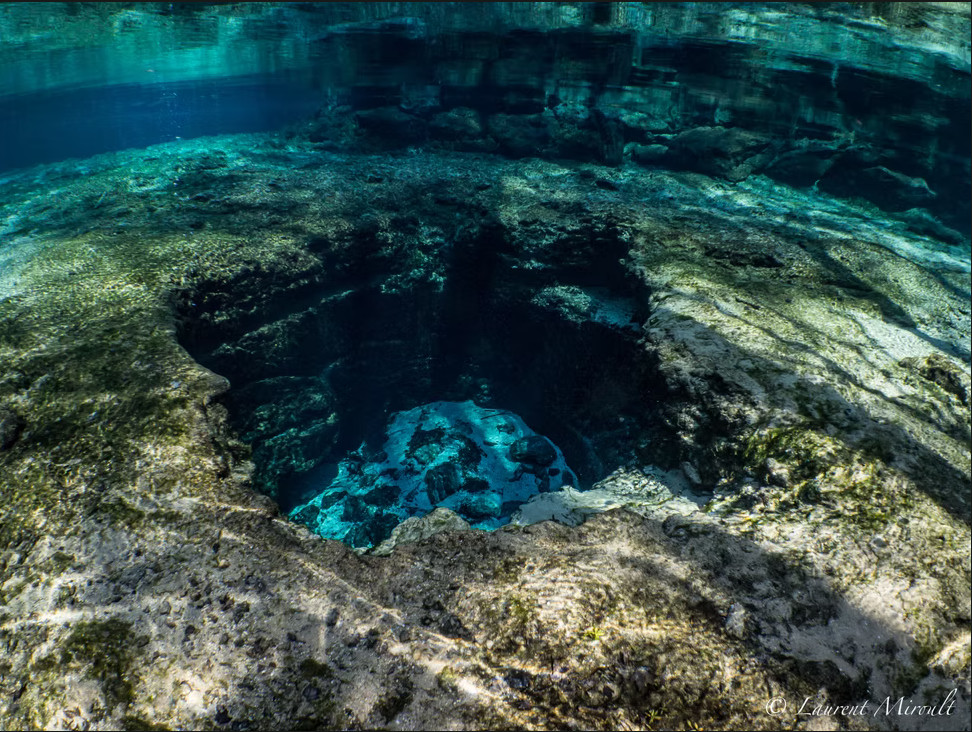
Situated at the confluence of the Santa Fe River and the Devil’s Spring Run, Devil’s Ear serves as one of the primary cave entrances within the Ginnie Springs system. The entrance opens into a major underwater conduit that has been explored and surveyed for miles beneath the surrounding landscape.
Devil’s Eye
Located adjacent to Devil’s Ear on the opposite side of the river confluence, Devil’s Eye provides another entrance into the Ginnie cave system. The spring is known for its distinctive opening and connection to the broader network of underwater passages.
Little Devil’s Spring
Little Devil’s Spring is a smaller but significant entrance within the Ginnie Springs complex. The site is a sidemount only opening that has not physically been connected to the main Devil’s Cave System.
Hornsby Spring
Hornsby Spring is a former first-magnitude spring located along the Santa Fe River. Only accessible from the Santa Fe River through a mile-long spring run, the spring has long attracted divers, paddlers, and visitors while serving as an important component of the basin’s hydrology.
Poe Spring
Poe Spring is one of the basin’s most popular public springs. Although better known for recreation than cave diving (due to cave diving being prohibited there), the spring contributes to the region’s extensive groundwater discharge system.
Rum Island Spring
Rum Island Spring emerges along the Santa Fe River and provides another example of the basin’s interconnected groundwater network. The spring’s clear water and scenic setting make it a popular destination for visitors exploring the region.
Blue Spring
Blue Spring contributes to the basin’s collection of spring systems and serves as another outlet for groundwater moving through the Floridan Aquifer beneath north-central Florida.
Exploration History
The Santa Fe River Basin has played a significant role in the development of modern cave diving.
Many exploration techniques, training methods, and survey practices were refined within the basin’s springs and cave systems.
Decades of exploration have documented extensive underwater passage throughout the region, contributing to a greater understanding of groundwater movement and karst development. New discoveries and survey work continue to expand knowledge of these interconnected systems.
Hydrology
The Santa Fe River Basin provides one of Florida’s most remarkable examples of karst hydrology. Near O’Leno State Park, the Santa Fe River disappears underground through a series of sinks before reemerging several miles downstream at River Rise.
This phenomenon demonstrates the direct interaction between surface water and groundwater that defines much of the basin.
Dye tracing, cave surveys, and hydrological studies have revealed numerous connections between springs, sinkholes, and underground conduits throughout the region.
Ecological Importance
The springs and waterways of the Santa Fe River Basin support diverse ecosystems that depend upon clean groundwater and stable spring flows.
Spring-fed habitats provide refuge for fish, turtles, aquatic vegetation, and numerous other species. The health of these ecosystems is closely linked to the condition of the Floridan Aquifer and the groundwater systems that sustain them.
Legacy
The Santa Fe River Basin represents one of Florida’s most important karst regions. Its springs, cave systems, and groundwater networks have contributed significantly to scientific research, cave exploration, and public appreciation of Florida’s hidden underground environment.
From Ginnie Springs and Devil’s Ear to the Santa Fe River sinks and River Rise, the basin continues to provide valuable insight into the relationship between geology, groundwater, and cave development.
Current Status
The Santa Fe River Basin remains one of the most active regions for cave exploration and groundwater research in Florida. Exploration projects, survey efforts, and scientific studies continue to improve understanding of the basin’s extensive cave systems and hydrological connections.
Advances in mapping technology, underwater photography, and cave-diving equipment continue to refine documentation of these systems, while ongoing research provides insight into groundwater flow, aquifer dynamics, and karst development throughout the region.
Today, the basin remains a vital resource for scientific study, recreation, exploration, and environmental monitoring.
See also: Maps of Cave Systems in the North Florida
Return to Florida Cave Systems
Frequently Asked Questions
The Santa Fe River Basin is a watershed in north-central Florida known for its springs, sinkholes, and underwater cave systems connected to the Floridan Aquifer.
The Santa Fe River disappears underground near O’Leno State Park and reemerges several miles downstream at River Rise, demonstrating one of Florida’s most remarkable karst features.
Not all springs are directly connected, but many are linked through complex groundwater pathways within the Floridan Aquifer.