
Weeki Wachee Springs
Overview
Weeki Wachee Springs is one of Florida’s most recognizable springs, combining a large groundwater discharge, an extensive underwater cave system, and a long history of tourism. Located in Hernando County along Florida’s Nature Coast, the spring is the source of the Weeki Wachee River. Its clear blue water and strong flow have made it a natural attraction, while the famous mermaid performances have given the site a place in Florida’s tourism history.
The spring is also significant beneath the surface. Its underwater cave system extends deep into the limestone and has been explored to depths exceeding 400 feet. The cave is part of a broader karst landscape that includes additional springs and sinkholes connected to the Weeki Wachee springshed.
The river flows approximately 7.5 miles from the main spring toward the Gulf. Along the way, it passes through forested banks, aquatic vegetation, residential areas, wetlands, and estuarine habitat.
Weeki Wachee is more than a tourist attraction. It is a major groundwater discharge system that supports a spring-fed river and provides habitat for fish, turtles, birds, and other wildlife.
Geological Context
Weeki Wachee Springs lies within Florida’s karst landscape, where groundwater gradually dissolves limestone and creates underground conduits. The underlying limestone includes fossil-bearing formations deposited in ancient marine environments. Over millions of years, these deposits became rock, and later groundwater movement dissolved portions of the limestone along fractures and other weaknesses. The process creates pores and conduits that can become large enough to form extensive underwater caves.
At Weeki Wachee, groundwater rises through a deep conduit and emerges into the spring basin. The cave system beneath the spring provides a direct example of the connection between the Floridan aquifer and surface-water discharge.
The surrounding area also contains other karst features, including Twin Dees Spring, sinkholes, and the submerged feature known as Hospital Hole. These features demonstrate how groundwater movement can create a network of springs, caves, and sinkholes within a single region.
The Weeki Wachee Spring
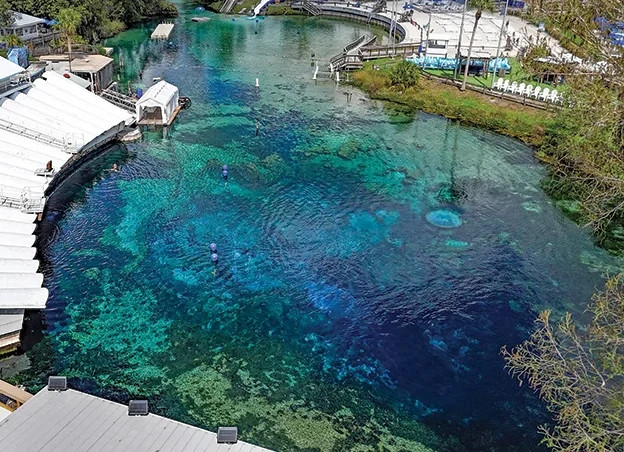
Weeki Wachee is a first-magnitude spring, discharging more than 64.6 million gallons of groundwater per day under the standard first-magnitude classification. The spring basin is more than 150 feet across and approximately 45 feet deep at its center. Water emerges from a deep fracture and cave conduit, creating the clear blue appearance for which the spring is known. The spring’s flow is substantial, and the current can be strong near the vent. The water remains cool throughout the year, making the spring a popular destination during Florida’s warmer months.
The spring is located within Weeki Wachee Springs State Park, where visitors can experience the water through designated swimming areas, the historic mermaid show, and other park attractions. Although the spring is widely associated with tourism, its underlying cave and aquifer system are important features of Florida’s groundwater environment.
The Weeki Wachee River
The Weeki Wachee River flows approximately 7.5 miles from the main spring to the Gulf. The upper river is a classic spring-fed freshwater environment, with clear water and relatively stable temperatures. Farther downstream, the river is increasingly influenced by tides and the mixing of freshwater with saltwater. The river supports submerged aquatic vegetation, fish, turtles, and other wildlife. Its clear water and natural scenery make it popular for paddling.
The lower river has been altered in places by dredged channels and residential development. These modifications contrast with the more natural upper river, where vegetation and wooded banks provide a more secluded setting. The river’s short length and connection to the Gulf make it an example of how groundwater discharge can sustain a coastal river while also interacting with an estuarine environment.
Structure & Underground Cave System
Weeki Wachee is notable for its extensive underwater cave system. The main spring basin is shaped like a broad cone, with a deep opening that connects to a fracture and a network of conduits in the limestone. Cave divers have explored passages extending to depths exceeding 400 feet below land surface. Exploration has revealed a system far larger than the spring basin visible from the surface.
The cave is also hydrologically important. Groundwater moves through the underground conduits before emerging at the spring, providing much of the flow that sustains the Weeki Wachee River. The system includes additional connections and features associated with Twin Dees Spring. Research has documented underground relationships between the main spring and the Twin Dees vents.
The cave environment is technically demanding and should not be confused with the open water recreation areas of the state park. Entry into an overhead environment requires specialized cave diving training, equipment, and planning.
Twin Dees Spring (Little Spring)
Twin Dees Spring, also known as Little Spring, is a separate spring feature associated with the Weeki Wachee River system. The spring discharges into the river through a tributary run downstream of the main spring. It is also notable for its underwater cave features.
Exploration and research have documented connections between the Twin Dees vents and the main Weeki Wachee cave system. This makes Twin Dees important to understanding how individual spring openings can be linked through underground conduits. Although Twin Dees belongs within the broader Weeki Wachee system, it has distinct surface access, hydrology, and cave features. It merits its own dedicated page linked from this hub.
Hospital Hole
Hospital Hole, also known as Fish Hospital, is a deep submerged sinkhole beneath the Weeki Wachee River. The feature is approximately 145 feet deep, depending on water level and tidal conditions. Its shape and internal water conditions distinguish it from the surrounding river. A cloudy layer within the sinkhole has contributed to the feature’s reputation. Local legend holds that sick or injured fish enter the hole to recover, giving it the name Hospital Hole.
The feature is a separate karst structure rather than part of the main spring basin. Its depth and underwater conditions make it of interest to divers, but its location within a river environment and its potential hazards require caution. Hospital Hole is best treated as an individual karst feature associated geographically with the Weeki Wachee River, rather than automatically considered part of the main spring cave.
Exploration History
Weeki Wachee’s exploration history includes both public tourism and underwater cave research. In 1947, the spring became the home of the famous mermaid show, developed by Newton Perry. The performances used the spring’s clear water and underwater setting to create an attraction that became internationally known. The site grew into one of Florida’s iconic roadside attractions, drawing visitors to the mermaid theater and spring basin.
Underwater exploration later revealed another side of Weeki Wachee. In 2007, divers discovered new passages and helped establish the system as the deepest known freshwater cave system in the United States. Subsequent exploration has continued to document the cave and investigate connections among the main spring, Twin Dees, and other karst features.
The combination of a major tourist attraction and a deep underwater cave system makes Weeki Wachee unusual among Florida springs.
History & Cultural Significance
The name Weeki Wachee is commonly translated as “little spring” or “winding river,” reflecting the area’s Indigenous linguistic heritage. The spring’s modern tourism history began in 1947, when Newton Perry developed the underwater mermaid attraction. Perry had experience with underwater performance and training, and the spring’s deep, clear water offered a distinctive setting. The mermaid show became a major attraction during the era of Florida’s roadside tourism. Visitors watched performers swimming underwater in the spring’s natural environment, supported by breathing systems that allowed them to remain submerged.
Weeki Wachee later became a Florida state park, preserving both the natural resource and its cultural history. Today, the park combines the mermaid show with swimming, paddling, wildlife viewing, and interpretation of the spring’s geological significance.
Paddling & Recreation
The Weeki Wachee River is a popular paddling destination, known for its clear water, gentle downstream movement in many sections, and abundant vegetation. Canoes, kayaks, and paddleboards can be used on designated sections of the river. The upper river offers a more natural spring-run experience, while the lower river becomes more developed as it approaches the Gulf. Paddling access, launch locations, and operating conditions vary. Visitors should check current park rules and river conditions before planning a trip.
The state park also offers the mermaid show and designated swimming opportunities. Because the spring is a deep, flowing groundwater opening, swimming areas and show areas should not be treated as unrestricted access to the cave system.
- Check current state park hours, ticket prices, and activity availability before traveling.
- Confirm river access and paddling arrangements before planning a trip.
- Remain within designated swimming and recreation areas.
- Do not enter the underwater cave without appropriate cave diving training and authorization.
- Protect aquatic vegetation and avoid disturbing wildlife.
- Check current water levels and river conditions before paddling.
- Remember that the lower river is affected by tides and transitions to brackish water near the Gulf.
Wildlife & Habitat
The Weeki Wachee River supports freshwater and estuarine habitats along its course. The upper river contains submerged vegetation and provides habitat for fish, turtles, and aquatic invertebrates. The surrounding forest and wetlands support birds, river otters, and other wildlife. As the river approaches the Gulf, salinity increases and the habitat transitions toward an estuarine environment.
The spring’s groundwater discharge helps maintain water temperature and flow. Changes in groundwater quality, spring discharge, or aquatic vegetation can affect the river’s ecological health. The broader springshed is therefore important to the health of the river, even in areas well beyond the state park.
Hydrology
The Weeki Wachee springshed covers approximately 240 square miles in northern Pasco County and southwestern Hernando County. Rainfall across this area replenishes groundwater in the Floridan aquifer. Groundwater then travels through limestone conduits and emerges through the main spring and associated vents. The main spring provides most of the river’s flow, while Twin Dees and other springs contribute additional groundwater.
The upper river is predominantly freshwater and has limited tidal influence. Farther downstream, tidal effects become more noticeable and the river transitions toward brackish conditions. The relationship between groundwater recharge, underground conduits, spring discharge, and coastal water levels is central to understanding the Weeki Wachee system.
Conservation
Weeki Wachee Springs is a designated Outstanding Florida Spring and a priority water body for the Southwest Florida Water Management District. Important environmental challenges include nutrient enrichment, sedimentation, potential reductions in historical spring flow, and losses of desirable aquatic vegetation. The springshed includes developed areas where land use can influence groundwater quality. Nutrients and runoff entering the aquifer can eventually affect spring water and the river ecosystem. Conservation efforts include monitoring spring flow and water quality, protecting wetlands, and managing recreational use. Because the cave system is part of the groundwater conduit network, protecting the surface spring also requires protecting the larger aquifer and the land that supplies it.
Current Status
Weeki Wachee Springs remains a major Florida attraction and an important natural groundwater discharge system. Weeki Wachee Springs State Park provides access to the spring, mermaid shows, swimming, and designated recreation. The river is also popular for paddling, although launch arrangements and operating conditions can change.
The underwater cave system remains significant for exploration and groundwater research. Cave diving is a specialized activity that requires appropriate training, equipment, and access authorization where applicable.
The springshed continues to face water quality and habitat challenges, particularly nutrient enrichment, sedimentation, and potential changes in spring flow.
Visitors should check the current state park website for operating hours, tickets, river access, and activity updates before making a trip.
Return to Florida Cave Systems
Frequently Asked Questions
Yes. Weeki Wachee is a first-magnitude spring system.
The spring basin is approximately 45 feet deep at its center. The underwater cave extends much deeper, with explored passages exceeding 400 feet below land surface.
Yes. Weeki Wachee contains an extensive underwater cave system that has been explored by trained cave divers.
Twin Dees, also known as Little Spring, is part of the broader Weeki Wachee River system. Cave exploration has documented underground connections between its vents and the main spring system.
Hospital Hole is a deep submerged sinkhole beneath the Weeki Wachee River. It is approximately 145 feet deep, depending on water level and tidal conditions.
Weeki Wachee has hosted special events in which open water diving is permitted in the spring basin. Cave diving is only permitted under state permit.
The river flows approximately 7.5 miles from the main spring toward the Gulf.
The spring is famous for its underwater mermaid show, which began in 1947, as well as its clear water, spring-fed river, and extensive cave system.